
A blog series on life as a listed company, seen from a listed company CEO’s point-of-view.
Adjusting items in earnings reports are a form of financial art, and the stakes can be high.
In the 2010s, as a young analyst covering the IT company Tieto, I couldn’t help noticing the adjusting items worth tens of millions of euros that turned up in its earnings every year. Management explained that non-recurring items were, in a way, an ongoing part of their business model: some part of the business always needed restructuring. The market, and we analysts, were even told to expect these costs to run at around 1–2% of revenue each year. It left me wondering why these costs were adjusted out of the earnings reported to investors at all, if they were a permanent part of normal business…? To be fair, the reporting was transparent to investors and management’s credibility held up, even though other analysts noticed the practice too.
After Inderes listed, I thought we would never become what investors call a “one-off aristocrat.” For three years we reported only the raw figures, and our guidance was tied to reported EBITA.
Then came 2025. Board members with strong backgrounds in listed companies had been pushing for some time for us to guide on EBITA excluding non-recurring items and to add that figure to our regular reporting. The CFO backed the change. As a former analyst, I was against it. I lost the argument, and the new model was adopted. Once again, though, the board members brought wisdom from the company side of the table, and it proved useful.
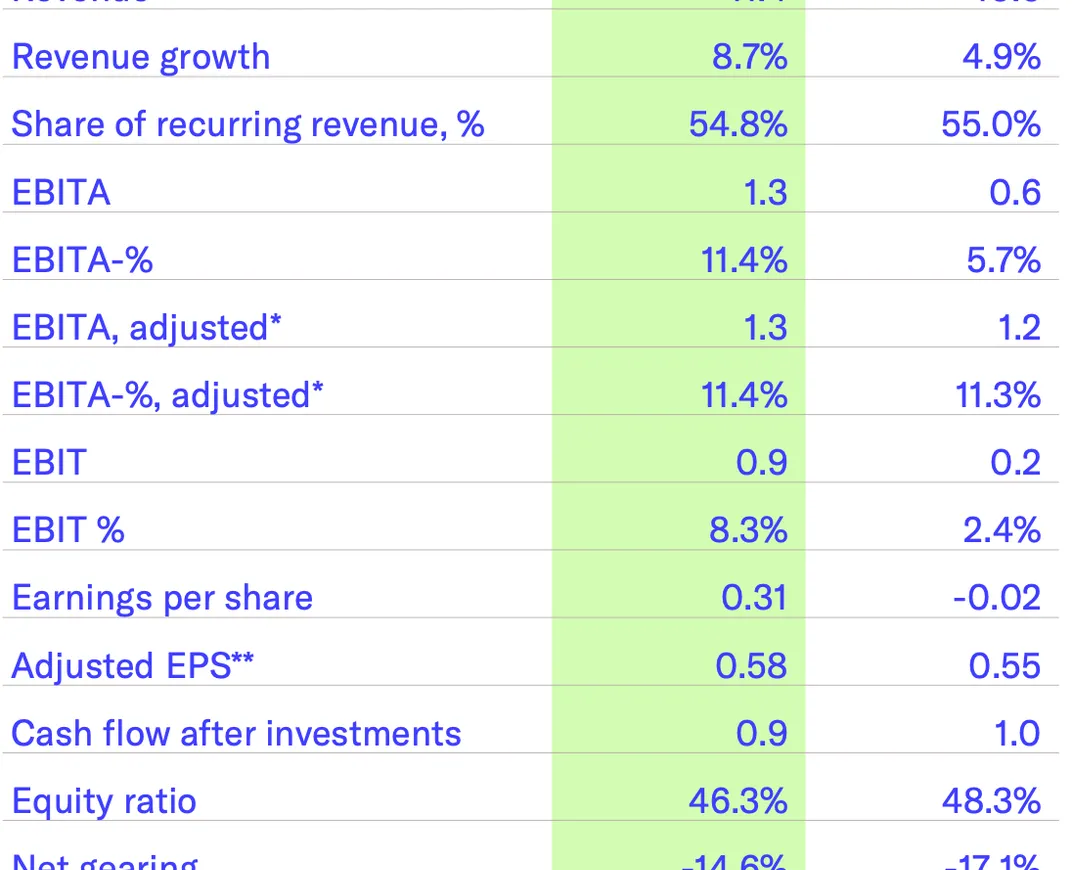
Figure: Key figures table from Inderes’ H1’26 half-year report. EBITA and earnings per share are shown on separate rows. Serving suggestion
Non-recurring items fall into two categories:
- Items paid out of the owners’ pockets, such as restructuring costs
- Purely accounting items with no cash flow impact, such as goodwill amortisation or impairment
Adjusting purely accounting items out of earnings is always justified, because it lets the reporting give a true picture of the state of the business. Many First North companies, Inderes included, report under FAS, where goodwill amortisation from acquisitions is a purely accounting item. Adjusting for it makes these companies more comparable with listed companies that apply IFRS. At Inderes, we have adjusted for these FAS items in our earnings per share from the start. This helps investors, for example when calculating P/E, the basic valuation multiple, and when tracking EPS growth. We also report EBITA as our primary metric. The final “A” in EBITA means it is operating profit before amortisation of intangible assets arising from acquisitions.
Non-recurring costs paid out of the owners’ pockets are harder to judge. Adjusting for them is justified, and adds transparency, when the costs are genuinely non-recurring and large enough to matter. The point of the adjustment is to show investors how healthy the operating business is and to give a more accurate picture. The danger is the constant temptation to slide into gimmickry that breeds distrust. If we push a few more costs over to the non-recurring side, won’t adjusted earnings look better? I remember one case in Finland that made the headlines, when a company said “non-recurring trade fair costs” had weighed on its quarterly result. Once sales costs become non-recurring, by the same logic you could start reporting revenue as non-recurring too.
Nobody tells a story like the Americans. When the office space provider WeWork felt that investors didn’t grasp how great the company was, or the huge hidden value in its community, it started reporting a “Community Adjusted EBITDA” figure to its financiers. This adjusted out marketing, administrative and development costs, among others, because what company could possibly run without those? A billion-dollar loss turned into a profit. At that point, investors quite rightly asked: do you take us for idiots?
WeWork’s extreme reporting holds an important lesson. It backfired badly on the company when investors and the financial press seized on it as brazen tinkering that underestimated investors. The erosion of financiers’ trust played a part in the collapse of the company’s valuation, the cancellation of its IPO and WeWork’s funding crisis.
Back to Inderes. We won’t become WeWork either, even though the Inderes community really is valuable.
In the second quarter of 2025, we had to restructure an events business we had acquired in Sweden, because we decided to move to a new operating model. As part of the acquisition, we had also entered into a partnership agreement that didn’t deliver the intended results and had to be terminated. This difficult but necessary operation ultimately cost EUR 0.6 million in cash-affecting costs. At Inderes’ scale, that was a significant hit to earnings, and it was genuinely non-recurring. Without the change in our guidance model that the board had pushed for, we would have painted ourselves into a corner: either take the necessary action and give the market a very severe profit warning, or leave the action undone and hope for the best.
Expanding our reporting to include adjusted operating profit, and giving guidance in terms of adjusted earnings, gives management room to make difficult decisions from time to time without having to start by issuing a profit warning to the market. When you face something like a challenging restructuring, no CEO wants extra public noise and pressure piled on top. That was the board members’ wisdom, which black-and-white analyst Mikael lacked. Every company runs into these situations at some point. It’s fine as long as the company doesn’t fall into a cycle of “non-recurring” items and restructurings that recur every year. If adjusted earnings sit systematically and clearly above reported earnings or cash flow, the items aren’t non-recurring. At that point, adjusted figures lose their credibility in investors’ eyes.
Thank you to everyone reading the blog for your feedback and conversations so far! If you’d like to follow Inderes’ life on the stock exchange even more closely, tickets for the journey are available on the First North marketplace at the day’s price. You can find the previous parts here:
