This blog series looks at life in the stock market from a listed company CEO’s point of view.
After Inderes went public, I received constant negative feedback about the poor liquidity of our share. There was a queue of people interested in the company, but daily trading of a few thousand euros on the exchange was an obstacle for all of them. Nor did any investor manage to build a meaningful holding in the IPO, as the EUR 5.7 million offering was more than eight times oversubscribed in just over 20 hours. There was no institutional tranche, so even the largest new shareholders got a few thousand euros’ worth of shares at most.
Some insisted that solving the liquidity problem should now be the CEO’s number one priority. I was more interested in building the business, and at that point I couldn’t see how such an operation would sensibly advance our strategy. And to be honest, I didn’t even know how you would go about fixing it in a situation where the vast majority of the shareholder base is locked up.
I concluded that, given our ownership structure, time would take care of it. And so it did in the end, a little too well.
This week, Nasdaq’s First North Day was held in Stockholm, celebrating 20 years of the First North growth market. Inderes had the pleasure of being a partner at the event. After the gloomy hangover of recent years, it came as something of a surprise even to me to hear in Nasdaq’s presentation that First North has delivered rather good returns over the long term, even though the index’s return figures are dragged down by companies transferring to the main list (the best-performing shares hop from the index to the main list, while the laggards stay on board).
Nasdaq has plenty of other reasons to sing the praises of Nordic First North. Over its history, 561 companies have listed there, EUR 32 billion of capital has been raised and 150 companies have moved up to the main list. It has clearly outperformed the growth markets of other European exchanges. Sweden is the admired star of the European capital market, but Finland has nothing to be ashamed of in the comparison either. On the First North lists, as much as 40% of daily share turnover comes from retail investors, meaning the list has given the general public access to earlier-stage growth companies. First North liquidity has picked up clearly from the lows of 2025, which is a good signal. There has also been more IPO news in recent weeks, in both Helsinki and Stockholm.
Still, the present moment feels depressingly bleak from the perspective of both the listed companies and investors. First North Helsinki is once again breaking all-time lows, and things don’t look any better in Stockholm. The five-year return is -69%. As it happens, Inderes is celebrating its fifth birthday on First North at exactly the same time. The index peaked almost on the day we listed.
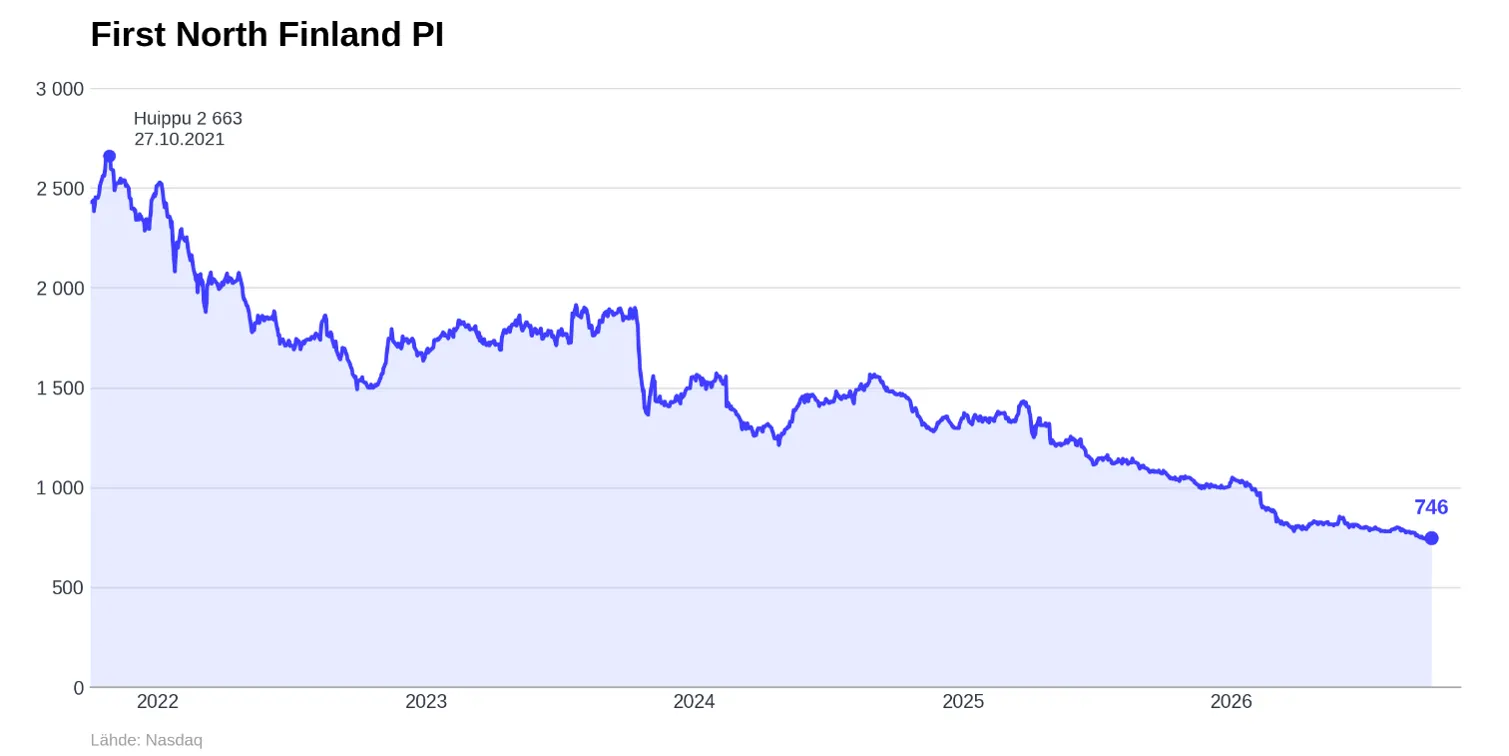
First North Finland PI — five years of decline. Peak: 2,663 on 27 October 2021. Current: 746. Source: Nasdaq.
One reason for the hangover is that money is still fleeing small-cap funds en masse, as Professor of Finance Vesa Puttonen writes in Sijoitustieto. When thinly traded shares are force-sold, share prices take an ugly beating unless the company’s earnings are rising steeply. One Stockholm banker told me, half laughing, that First North companies’ earnings releases and news are “nothing but liquidity windows in which these fleeing shareholders get to sell the share”. Well put. On good news, only the trading volume goes up, and the share price treads water.
Puttonen notes that small companies shouldn’t expect equity funds to turn up as investors. If there is a small-cap fund on your shareholder list right now, it is more likely to be on the sell side.
There are CEOs on Helsinki’s small-cap list who are in utter despair over this, a professional board member I know tells me. If your company happens to be pigeonholed by the market into a loser category that investors are currently shunning, there is little you can do about it. It may be a waste of time to focus your investor relations on a fund audience that is selling anyway.
There is something you can do, though, if your patience holds. Here are my own tips for a repair kit:
- Buying back your own shares should be a no-brainer. For some reason, the boards of many small companies are timid about this.
- Invest in retail investors. Sentiment is dismal there too, but the first seasoned cigar-butt pickers are already on the move.
- Think about new themes or angles for your equity story that could spark interest and position the company in a growth category.
- Delivering strong numbers is ultimately the surest way to win investors’ interest, although that takes time too. A few good quarters are not enough.
- Be patient. Cyclicality is part of life in the capital markets.
- Don’t blame “the stock market”. It solves nothing.
The early-days liquidity problem of the Inderes share has been resolved amid the turmoil, as our already dispersed shareholder base has started to turn over. We are one of the most liquid shares on the small-cap list. In the best weeks, one percent of the company changes hands. If someone wanted to join the ranks of our largest shareholders, at current volumes it wouldn’t take many months. Yet stirring up investor interest feels harder than ever, and many companies share that challenge. To my delight, I have noticed new investors starting to appear on our shareholder list. And Inderes itself has climbed to the top spots on the list through its share buyback programme.
As an investor, I try to avoid hype trends and go through the bins instead. I love investing in themes that gloom has taken over. I’m excited about First North and small caps precisely because sentiment is so sour, even though as a CEO it feels heavy at times. I have sold every sellable large-company share in my portfolio and put everything into small caps (and, of course, Inderes shares). If the basics of finance theory I once learned in Professor Puttonen’s lectures still hold at all today, the current hangover cannot go on forever, provided small companies’ earnings move even slightly in the right direction.
Perhaps it also says something about the deflated mood of our times that one CEO’s massive investment in his own company can be turned into a sneering newspaper headline. Surely sentiment can’t get any worse than this — or can it?
